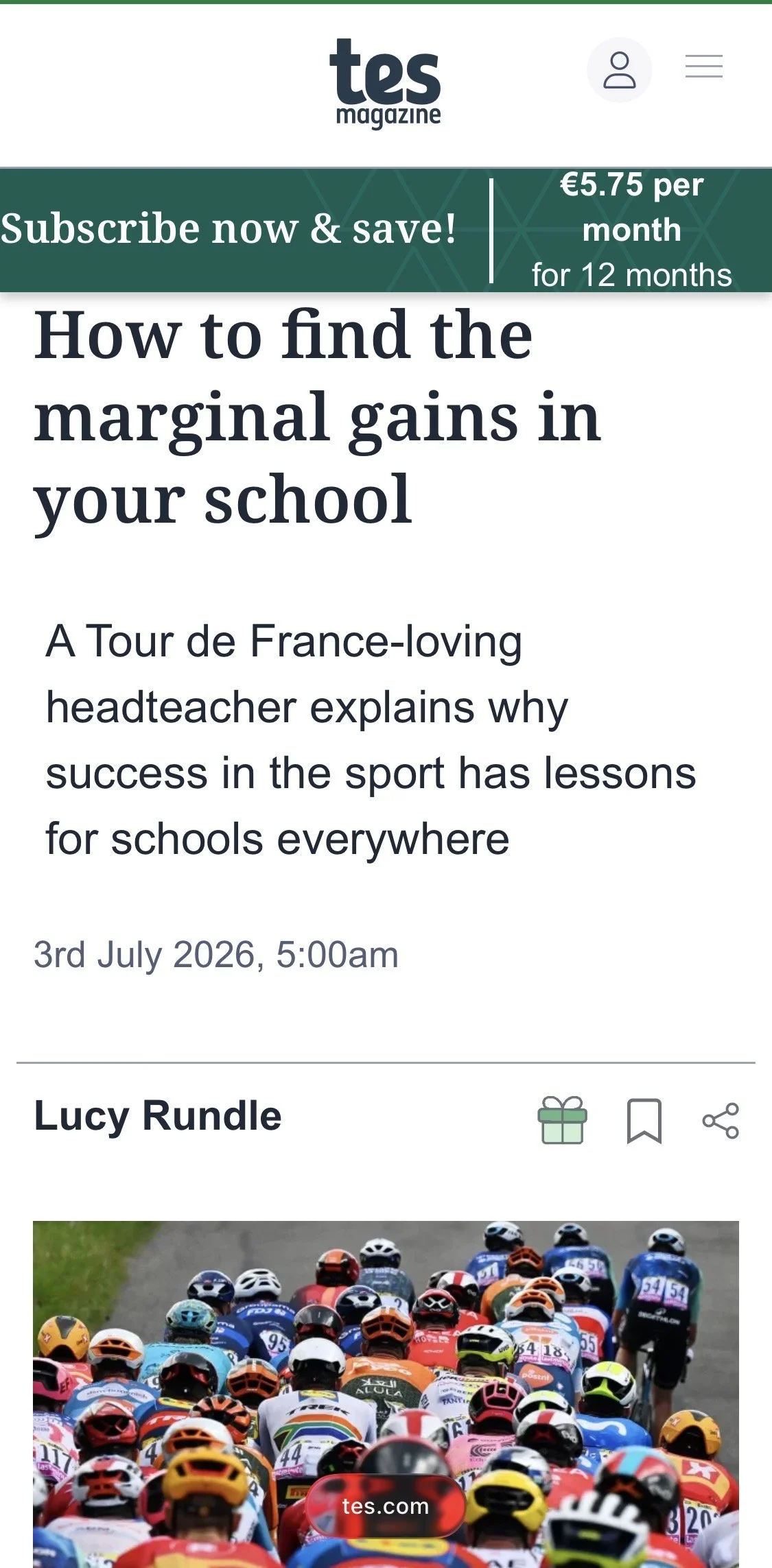
What the Tour de France taught me about school leadership
I’ve loved the Tour de France for years.
Every July, for three weeks, my evenings are spoken for. While some people switch on the latest drama or box set, I’m glued to the Tour de France highlights. I love everything about it: the tactics, the teamwork, the mountain stages, the spectators, the scenery and the incredible resilience, power and strength of the athletes.
But the thing that fascinates me most isn’t always most apparent: the leadership.
One of the ideas I’ve always admired is Dave Brailsford’s philosophy of marginal gains.
The principle is beautifully simple: improve lots of small things by just 1% and, together, those tiny improvements can have a remarkable cumulative effect. So much so his team have won the epic race multiple times.
Some of those improvements are deeply unglamorous. For example, riders brought their own pillows to improve the quality of their sleep. They were taught proper handwashing techniques to reduce the spread of illness during a three-week race.
Nobody wins the Tour because of a pillow. Nobody stands on the podium because they washed their hands. But together, these tiny details created the conditions for elite performance.
That idea has stayed with me for years and I realised I’d been trying to apply it in schools without really having a name for it.
I’m delighted that this idea captured the attention of the Times Educational Supplement who published my article about it this weekend.
https://www.tes.com/magazine/leadership/strategy/tour-de-france-find-marginal-gains-school
This blog unpicks a few more of the real life stories that demonstrate friction in schools
The Technology Friction
One day there was a gentle knock on my office door.
“I feel really bad asking… but if there’s any spare money for a new laptop, mine’s really slow and sometimes just randomly closes down.”
On the face of it, she was asking for a laptop.
She wasn’t.
She was telling me that something was getting in the way of her doing her job well.
My response wasn’t, “There’s no money.”
Instead, I thanked her for telling me and made it a priority to get it sorted.
An urgent IT ticket was logged and, if it couldn’t be repaired, we’d replace it.
That wasn’t being frivolous with taxpayers’ money.
It was recognising that highly skilled teacher time was being wasted waiting for a computer to load.
Those minutes don’t sound like much.
But they add up.
The Stationery Cupboard Friction
I was due to cover a lesson where every child would need a Post-it note.
There weren’t any in the classroom.
So I walked three minutes to the stationery cupboard.
Locked.
I then walked to the admin office, waited while someone finished on the phone, asked where the key was, walked back with them while they tried several different keys before eventually finding the right one.
I was handed some Post-it notes.
The cupboard was locked again like Fort Knox.
Only when I got back to the classroom did I realise I’d picked the wrong colour. One pupil needed yellow for visual processing.
There wasn’t time to go back.
No wonder so many teachers quietly stop asking and buy their own resources instead.
Twenty-eight pencils
Another memory has always stuck with me when having to practically beg to replace some stubby chewed pencils for my class
“How many pencils do you need?”
“I don’t know… just give me a handful.”
“How many children are in your class?”
“Twenty-eight.”
“I’ll just give you twenty-eight then.”
She carefully counted them out one by one while I stood there mentally calculating everything else I could have achieved during those precious minutes.
The pencils weren’t the problem.
The process was.
Three whiteboard pens
Every teacher has experienced this.
You’re just about to launch into a mini whiteboard activity.
Three pupils announce their pens have run out.
The flow of the lesson disappears.
You interrupt yourself.
Children wait. Behaviour spikes.
Learning stops.
Wouldn’t it be easier if there were simply enough pens for pupils to quickly replace them independently without disturbing the lesson?
When I became a headteacher, I decided this wasn’t going to be a problem in my school.
Teachers could have as many pencils, glue sticks and whiteboard pens as they needed.
Need being the important word.
Because I’d much rather highly qualified professionals spent their time planning brilliant lessons than hunting for stationery.
The domestiques in school
One of my favourite parts of the Tour de France is watching the domestiques. They’re the riders who fetch bottles, shield the team leader from the wind and quietly sacrifice their own race so somebody else can perform at their very best.
They rarely receive the headlines. But without them, nobody wins.
When I appointed a new member of the admin team, I probably spent longer than most headteachers explaining my vision.
I told her she wasn’t “just admin.” She was one of our domestiques. Her role wasn’t simply to answer the phone or process paperwork. It was to remove friction from teachers’ lives wherever she found it.
She organised family feedback meetings properly, chased trip payments and letters, filtered emails and phone calls, solved problems before they landed on teachers’ desks and constantly asked herself one question:
“Is this something a teacher really needs to be doing?”
It completely transformed the way she viewed her role. And it transformed the way teachers experienced it too.
Unnecessary Admin Tasks Friction
I worked for one head who was also passionate about ensuring teachers can get on and teach. She delegated all trip and experience planning to one person so no teachers were burdened with it. Teachers also didn’t have any additional subject leadership responsibilities. It’s the classic primary school teacher problem. You’re landed with a random subject you have no specialism or interest in and have to find time to read about it, monitor it, collect data, organise resources etc (Please send help if any primary teachers are still being judged on this as part of performance related pay appraisal). All that causes an additional layer of stress. She just wanted teachers to focus on teaching. Teaching is hard enough as it is without wasting energy on tasks other people can do well.
System Friction
Removing friction isn’t always about spending money. Sometimes it’s about redesigning systems.
I remember a colleague completely redesigning the behaviour logging process. The original system took around fifteen clicks to record one behaviour incident. By the end of a busy day, some incidents simply weren’t logged. Not because teachers didn’t care. Because they were exhausted and 15 clicks tipped them over the edge and didn’t seem worth the effort.
He spent time redesigning the system and stripped it right back. Fewer clicks and a simpler process. The result wasn’t just happier teachers. It was better data and more accurate records leading to better understanding and decisions. In this case, making life slightly quicker and thus easier for teachers also improved school behaviour.
Seven seconds that save hours
Then there was the shared drive. I dread to think how many hours I’ve wasted searching for resources. Texting colleagues, trying to remember a keyword, clicking through endless folders hoping I’d stumble across the right document.
Eventually I decided enough was enough.
We reorganised everything and agreed a consistent way of naming files.
Not “Planning Week 3”.
But “History, Y4, Vikings, Wk3, King Cnut scaffold.”
Yes, it takes another seven seconds to type. But it saves countless minutes for every teacher looking for that resource next year—or the year after that.
Another marginal gain and one with lasting benefits!
The school equivalent of a better pillow
None of these stories will ever appear in a school improvement plan.
Nobody is inspected on the organisation of their shared drive.
Nobody receives an Outstanding judgement because the coffee machine works or the stationery cupboard stays stocked.
Yet these things matter to me. Because they create the conditions in which teachers can focus on what only teachers can do.
That’s the surprising lesson I’ve taken from watching the Tour de France over the years. The television cameras naturally follow the rider in yellow. But it’s way more interesting to find out what’s happening behind the scenes.
Because the more time I’ve been in school leadership, the more I realise I want to find those marginal gains and quietly remove the friction to ensure teachers can focus on the job in hand.
One small improvement at a time, I like to think I am creating the conditions for everyone else to perform at their very best. They may not win the Tour de France but I’m happy if they teach a cracking lesson.